


📋 In This Article
- The Core Definition Difference
- Strata Cleaning
- Commercial Cleaning
- The Overlap
- Difference 1 Scope of Services
- Strata Cleaning Scope
- Commercial Cleaning Scope
- Why the Scope Difference Matters
- Difference 2 Frequency & Scheduling
- Strata Cleaning Frequency
- Commercial Cleaning Frequency
- The Practical Implication
- Difference 3 Compliance & Documentation
- Strata Compliance Documentation
- Commercial Compliance Documentation
- Why It Matters at Contract Time
- Difference 4 Contracting & Billing
- Strata Contracting Structure
- Commercial Contracting Structure
- Practical Implications
- Difference 5 Pricing Structure
- Strata Pricing Structure
- Commercial Pricing Structure
- When the Pricing Models Cross Over
- Difference 6 Tenant & User Interaction
- Strata Cleaning Interaction
- Commercial Cleaning Interaction
- When You Need Both
- How to Choose the Right Contractor
- Frequently Asked Questions
- Get the Right Service Quote Strata or Commercial
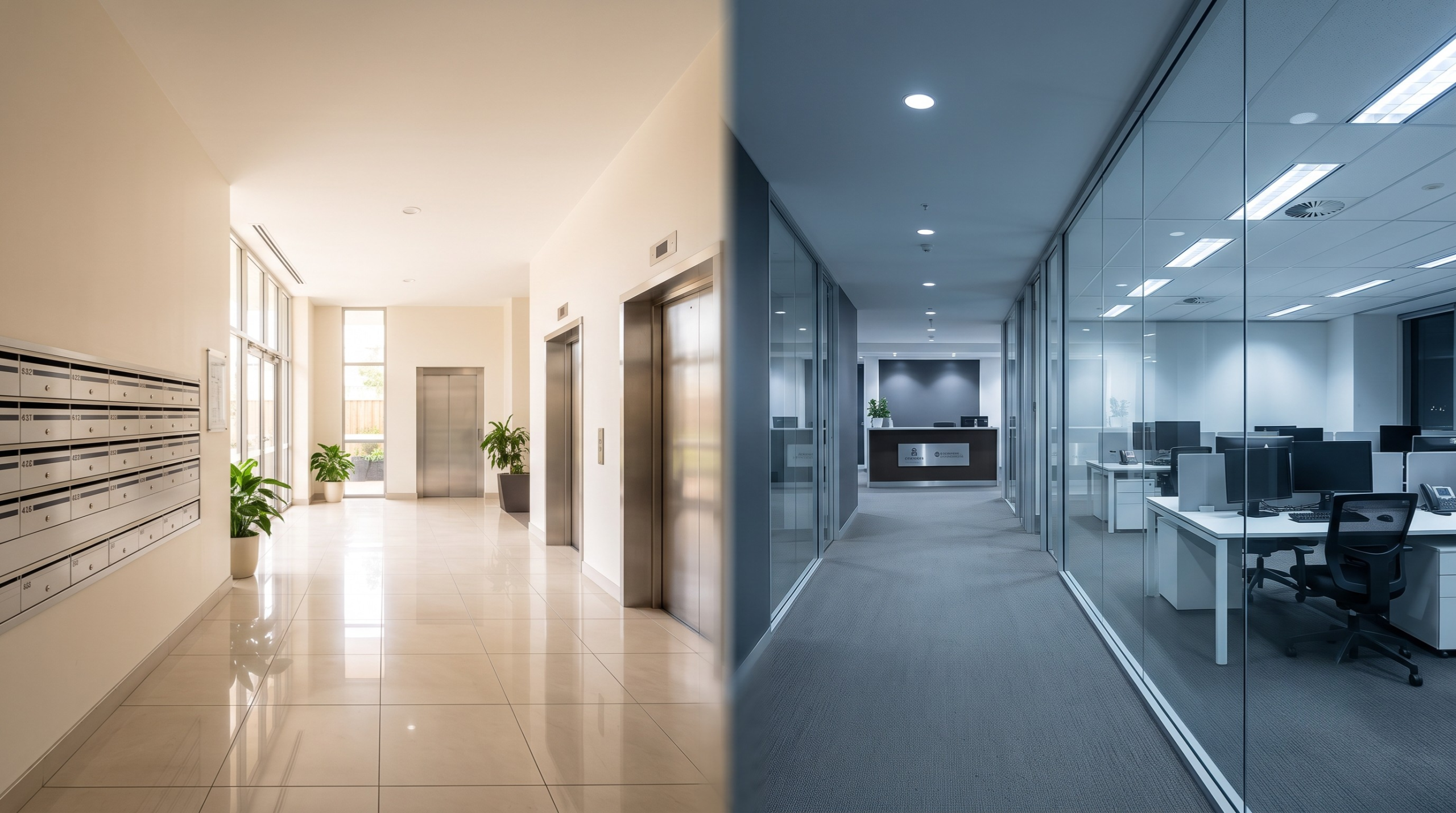
The short answer: Strata cleaning and commercial cleaning are different services with different scope, frequency, contracting structures, and compliance requirements even when delivered by the same provider. Strata cleaning maintains common areas in multi-unit residential buildings (lobbies, lifts, corridors, bin enclosures) and reports to body corporates, owners corporations, or strata managers. Commercial cleaning maintains tenanted business premises (offices, retail, warehouses) and reports to property managers, business owners, or facility managers. The wrong service category for your building results in over-paying for unused features or under-scoping for missed compliance.
For property managers, business owners, body corporate committees, and anyone responsible for organising building maintenance — choosing between “strata cleaning” and “commercial cleaning” is more than semantics. The wrong choice means contracts that don’t fit, line items that don’t apply, and reporting that doesn’t satisfy the right stakeholders.
This guide breaks down the six key differences and explains when each service is appropriate.
The Core Definition Difference
The distinction is about who lives or works in the building and who governs the cleaning contract.
Strata Cleaning
Strata cleaning serves multi-unit residential (and some mixed-use) properties where:
- Multiple owners hold individual units in the building
- A body corporate (Vic) or strata company (WA) governs common property
- Cleaning is funded from owner levies, not rent
- Cleaning quality is evaluated by owners and tenants who live in the building
Typical strata buildings: apartment complexes, townhouse complexes, retirement villages, mixed-use buildings with residential units, gated residential communities.
Commercial Cleaning
Commercial cleaning serves tenanted business premises where:
- Building is owned by a landlord or property fund
- Tenants are businesses occupying leased space
- Cleaning is funded through the lease arrangement (sometimes by tenant, sometimes by landlord)
- Cleaning quality is evaluated by office staff, business owners, or facility managers
Typical commercial buildings: office buildings, retail centres, warehouses, medical clinics, dental practices, restaurants, retail strips.
The Overlap
Some buildings need both services. A mixed-use building with ground-floor retail and upper-floor apartments needs commercial cleaning for the retail tenancies (separate contract with retailers) and strata cleaning for residential common areas (single contract with body corporate). The two services run in parallel.
Difference 1 Scope of Services
The biggest practical difference between the two service categories.
Strata Cleaning Scope
- Bin management (presentation, return, hygiene) — see strata bin management service
- Common area cleaning (lobbies, lifts, corridors, stairwells)
- Communal amenity cleaning (gyms, pool areas, function rooms)
- Window cleaning (lobbies, common-area glass)
- Gutter cleaning (strata gutter cleaning)
- Carpet steam cleaning (corridors, lobbies)
- Pressure washing (driveways, façades)
- Caretaking and grounds maintenance
Notably excluded: cleaning inside individual units (that’s the lot owner’s responsibility).
Commercial Cleaning Scope
- Office space cleaning (desks, kitchens, meeting rooms, break-out areas)
- Restroom and washroom hygiene (deep cleans, restocking consumables)
- Floor care (vacuuming, mopping, polishing)
- Kitchen and tea-point cleaning
- Window cleaning (internal glass partitions and external windows)
- Periodic deep cleaning (carpet shampoo, hard-floor strip-and-seal)
- Specialty cleaning (medical clinic infection control, food premises sanitation)
Notably excluded: shared building exteriors or common areas if the building has multiple commercial tenants (that’s the property owner’s responsibility through a separate base-building contract).
Why the Scope Difference Matters
A strata committee asking for a “commercial cleaner” often receives a quote for desk cleaning and washroom restocking — useless for an apartment building. A commercial property manager asking for a “strata cleaner” often receives a quote excluding the office cleaning their tenants actually need. Getting the category right at the quote stage saves weeks of back-and-forth.
Difference 2 Frequency & Scheduling
Strata and commercial cleaning operate on fundamentally different rhythms.
Strata Cleaning Frequency
- Bin management: weekly (council collection days)
- Common area light cleaning: weekly or fortnightly
- Common area deep cleaning: monthly
- Window cleaning: quarterly
- Carpet steam cleaning: twice-yearly
- Gutter cleaning: twice-yearly
- Pressure washing: annually
Most work happens during daytime business hours when residents are at work. Some buildings restrict cleaning hours to avoid noise complaints during quiet times.
Commercial Cleaning Frequency
- Office cleaning: daily (Monday-Friday) for most premises
- Restroom hygiene: twice-daily for high-traffic offices
- Bin management: daily internal bin emptying
- Window cleaning: quarterly or bi-monthly
- Carpet steam cleaning: quarterly or twice-yearly
- Periodic deep cleaning: quarterly
Most work happens after hours typically 5 PM-10 PM or 5 AM-8 AM to avoid disrupting business operations. Weekend cleaning is common.
The Practical Implication
A contractor running a strata cleaning crew can’t simply pivot to commercial cleaning the next building over. The schedules, equipment, and team workflow are different. Reputable providers either specialise in one category or run separate crews for each.
Difference 3 Compliance & Documentation
Both service categories have compliance requirements, but the documentation flows to different stakeholders for different purposes.
Strata Compliance Documentation
- Monthly photo reports to body corporate / strata manager
- Annual AGM package showing 12 months of completed work
- Body corporate AGM minutes referencing maintenance decisions
- Sinking-fund maintenance forecasts
- Insurance evidence for water-damage and structural claims
- Council compliance for waste and fire safety
Audience: body corporate members, strata managers, insurance underwriters, council inspectors.
Commercial Compliance Documentation
- Daily cleaning logbooks signed by cleaner
- WHS compliance records for cleaning chemicals
- Safety Data Sheets (SDS) for all chemicals used on site
- Cleaner induction records showing site-specific training
- Restroom hygiene logs
- Food premises sanitation records (where applicable)
- Medical clinic infection control logs (where applicable)
Audience: facility managers, WHS auditors, food safety inspectors, healthcare accreditation bodies.
Why It Matters at Contract Time
A strata committee won’t read daily cleaning logbooks they need monthly summaries. A facility manager won’t read AGM packages they need daily evidence the work happened. Specifying the wrong documentation type wastes contractor time on reporting nobody reads and leaves the actual stakeholders without what they need.
Difference 4 Contracting & Billing
The legal and financial structures differ substantially.
Strata Contracting Structure
- Contract holder: body corporate or owners corporation
- Procurement process: committee approval, often AGM vote for higher-value contracts
- Pricing model: monthly retainer for ongoing services, per-visit for episodic services
- Billing: monthly invoice to strata manager, who reconciles against levy budget
- Multi-stakeholder approval: changes require committee discussion
- Typical contract term: 12 months with rolling renewal
Commercial Contracting Structure
- Contract holder: building owner, head tenant, or facility management company
- Procurement process: facility manager or property manager decision, often tendered
- Pricing model: monthly retainer based on square metres and frequency
- Billing: monthly invoice to property manager or finance team
- Single-stakeholder approval: changes approved by facility manager directly
- Typical contract term: 12-36 months, often part of property management agreement
Practical Implications
Strata contracts move slower (committee approval cycles) but tend to be more stable once signed. Commercial contracts move faster but are also more vulnerable to renegotiation each lease cycle or property management change.
Difference 5 Pricing Structure
Both services charge similar hourly rates but structure pricing differently.
Strata Pricing Structure
Typically monthly retainer for ongoing services. See our strata cleaning cost guide for detailed pricing. Headline numbers:
- Bin management: $80-$450/month
- Common area cleaning: $300-$1,200/month
- Full-service contract: $800-$4,000/month
- Multi-building discount: 15-25% for 5+ buildings
Commercial Pricing Structure
Typically monthly retainer based on square metres × frequency × service level:
- Light daily clean: $1.20-$2.50 per m² per month
- Standard daily clean: $2.50-$4.50 per m² per month
- High-spec daily clean (medical, food): $5-$10 per m² per month
- Periodic deep cleans quoted separately
A 200 m² office cleaned daily at standard spec typically costs $500-$900/month. A 1,000 m² office at the same spec runs $2,500-$4,500/month.
When the Pricing Models Cross Over
For very small commercial premises (under 100 m²) and very large strata buildings (high-rise towers), the pricing models can produce similar quotes. But the underlying contract structure, frequency, and documentation requirements still differ.
Difference 6 Tenant & User Interaction
The day-to-day human interaction is fundamentally different.
Strata Cleaning Interaction
Cleaners work around residents who live in the building. Interactions include:
- Polite hello in lobbies and corridors
- Working around residents waiting for lifts
- Avoiding moving residents’ personal items (mail, packages)
- Handling complaints about noise during business hours
- Coordinating access to residents’ parking spaces for equipment
Privacy and respectfulness matter residents see cleaners regularly and form long-term relationships.
Commercial Cleaning Interaction
Cleaners typically work outside business hours. Interactions are:
- Brief security check-ins on arrival
- Limited overlap with cleaning staff and night-shift workers
- Strict confidentiality around documents on desks
- Working around IT equipment without touching personal items
- Reporting any damage or maintenance issues to facility manager
Discretion matters most cleaners often handle sensitive areas (executive offices, server rooms, restricted spaces).
When You Need Both
Some buildings genuinely need both services delivered in parallel:
Mixed-use buildings: ground-floor retail + upper-floor residential. Commercial cleaning for retail tenancies (separate contracts with each retailer); strata cleaning for residential common areas (single contract with body corporate).
Commercial strata buildings: office buildings where individual offices are sold as strata lots. Strata cleaning for common areas (lobbies, lifts, shared meeting rooms); commercial cleaning for each strata-owned office space (separate contracts).
Aged-care and retirement complexes: strata-style common-area cleaning for residential blocks; commercial-style specialty cleaning for medical clinics, gyms, dining facilities within the complex.
The key is recognising that “the building needs cleaning” can actually mean three or four different contracts depending on the building’s structure.
How to Choose the Right Contractor
The right contractor for your needs depends on building type but both categories share quality markers.
For strata buildings:
- Verify the contractor specifically services strata (not just commercial generalists)
- Confirm they provide monthly photo reports for body corporate records
- Check they understand body corporate / owners corporation governance
- Verify they offer multi-building portfolio pricing if your strata firm manages multiple sites
- Confirm 24-hour storm/emergency response
For commercial buildings:
- Verify after-hours cleaning capacity (most commercial work happens 5-10 PM)
- Confirm WHS documentation including SDS sheets and cleaner inductions
- Check specialty experience if you have medical, food service, or sensitive areas
- Verify they understand your specific industry compliance requirements
- Confirm consumables supply if you want them to restock toilet paper, soap, etc.
For multi-service properties:
Look for a contractor running genuine multi-service capability (not subcontracting). Single-vendor multi-service contracts typically save 15-25% over multiple specialist contracts due to scheduling efficiency.
Frequently Asked Questions
Q: Is strata cleaning more expensive than commercial cleaning? Not directly comparable. Strata cleaning is typically priced as a monthly retainer covering specific services (bin management, common areas, periodic visits). Commercial cleaning is priced per square metre per month for daily cleaning. A 1,000 m² office costs roughly $2,500-$4,500/month commercial; a 30-unit strata building with similar coverage costs roughly $1,500-$2,800/month strata. The strata is often cheaper because daily cleaning isn’t included.
Q: Can one contractor do both strata and commercial cleaning? Yes many established cleaning companies offer both. But verify they run separate crews for each rather than asking one team to switch between residential common areas during the day and commercial offices at night. The workflows, equipment, and supervision are different enough that combined crews typically deliver lower quality than specialised crews.
Q: We have a mixed-use building. Do we need two contracts? Yes usually. Commercial cleaning for retail/office tenancies and strata cleaning for residential common areas. Some contractors can deliver both under a single billing arrangement, but the work is still scoped, scheduled, and reported separately. Consolidating with a single contractor handling both saves admin overhead.
Q: Does my strata cleaning include cleaning inside my apartment? No. Strata cleaning covers common property only — lobbies, corridors, lifts, stairwells, bin enclosures, communal amenities, gardens, driveways. Inside individual units is the lot owner’s responsibility. If you want cleaning inside your apartment, you’d contract a separate residential cleaner.
Q: What kind of cleaning does my building actually need? For multi-unit residential buildings: strata cleaning. For business premises (offices, retail, warehouses, medical clinics): commercial cleaning. For mixed-use: both. If you’re unsure, request a free assessment — we’ll review your building structure, lease arrangements, and tenant mix, then propose the right service category.
Get the Right Service Quote Strata or Commercial
Dan’s Building Solutions provides both strata cleaning (Melbourne and Perth, including bin management and gutter cleaning) and commercial cleaning across all property types. We run specialised crews for each category to ensure scope, scheduling, and documentation match the building’s actual stakeholders.
Call 1300 006 000 or request a free assessment we’ll determine the right service category for your building and quote accordingly.
Related: Strata Bin Management Service · Strata Cleaning Cost Guide · Strata Maintenance Checklist · Switching Strata Bin Providers

← Previous
Communal Bin Compliance: What Body Corporates Need to Know (Melbourne & Perth 2026)
Next →
Switching Strata Bin Management Providers: A Body Corporate’s Playbook (2026)

Leave a Reply