


📋 In This Article
- Before You Start: The Honest DIY Decision
- Tools & Equipment Checklist
- Step-by-Step: How to Clean Your Gutters Safely
- Step 1 Choose the Right Day
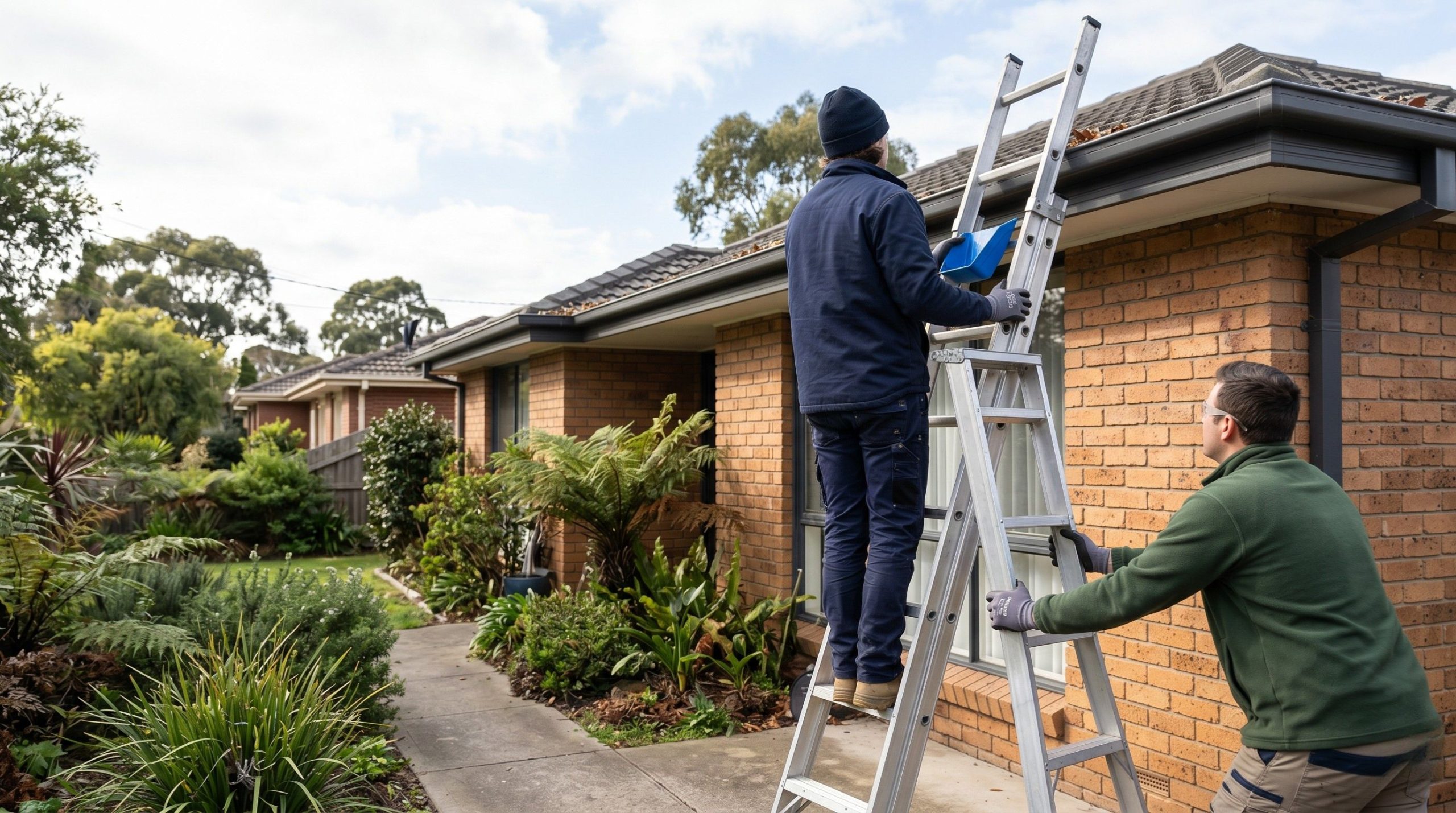
- Step 2 Set Up Your Ladder Correctly
- Step 3 Remove Large Debris by Hand
- Step 4 Flush Remaining Sludge
- Step 5 Inspect Downpipes
- Step 6 Dispose of Debris
- Step 7 Final Check
- Critical Safety Rules
- When NOT to DIY (Call a Pro Instead)
- Common DIY Mistakes That Cost Money
- Mistake 1: Hosing Debris Down the Downpipe
- Mistake 2: Putting Pressure on Gutters Through the Ladder
- Mistake 3: Missing Sludge at the Back of Gutters
- Mistake 4: Not Checking Downpipe Flow
- Mistake 5: Using a Pressure Washer
- DIY vs Professional Cost Comparison
- Frequently Asked Questions
- When DIY Doesn't Work, Call Us
The short answer: You can safely clean ground-level single-storey gutters yourself using a sturdy ladder, gloves, a scoop, a bucket, and a garden hose for flushing. Work in dry conditions, have a spotter, never overreach from a ladder, and stay clear of power lines. DIY is not recommended for double-storey or higher homes, tile or steep metal roofs, gutter guard systems, or chronic blockages. Falls from heights are the leading cause of DIY home injuries for anything above single-storey, hire an insured contractor.
This guide walks you through how to clean your own gutters properly and safely and is honest about when DIY stops making sense.
Before You Start: The Honest DIY Decision
Three questions to answer truthfully before you climb a ladder:
- Is your property single-storey with safe ladder access on all sides? If no, stop here. Hire a pro.
- Do you own (or can borrow) a sturdy A-frame extension ladder? Not a step ladder, not a folding ladder an extension or A-frame ladder rated for outdoor use.
- Will someone be home to act as a spotter while you work? Working alone at height is the single biggest predictor of serious injury.
If you answered yes to all three, this guide is for you. If any answer is no, see the when to call a pro section further down.
Tools & Equipment Checklist
For a proper DIY gutter clean, you’ll need:
- Extension or A-frame ladder fibreglass or aluminium, rated for outdoor use, with stabiliser feet
- Heavy-duty gloves leather or thick gardening gloves (gutters contain sharp metal edges, old screws, and occasional broken glass)
- Plastic gutter scoop or small trowel never use a metal scoop on Colorbond or coated gutters (scratches the protective layer)
- Bucket to collect debris, ideally with an S-hook to hang from the ladder
- Drop sheet or tarp to catch debris below if you’d rather not collect at height
- Garden hose with spray nozzle for flushing residual sludge and testing downpipe flow
- Safety glasses surprising what gets stirred up
- Closed-toe shoes with grip never sandals or thongs
- Phone in pocket emergency contact if something goes wrong
Total cost if you don’t own this gear: $250-$400 from Bunnings. That’s already in the range of a professional clean — worth knowing before you commit.
Step-by-Step: How to Clean Your Gutters Safely
Step 1 Choose the Right Day
Work only in dry, calm conditions. Wet gutters and ladders are slippery; wind makes ladders unstable. Avoid:
- Rain forecast within 6 hours
- Wind above 25 km/h
- Temperatures above 35°C (heat exhaustion at height)
- After dark or in low light
The day after a dry week is ideal debris is easier to scoop when dry.
Step 2 Set Up Your Ladder Correctly
Ladder positioning is the #1 cause of falls. The rules:
- Place ladder on firm, level ground never on grass, soft soil, or a slope
- Use the 1-in-4 rule: for every 1 metre of vertical height, base of ladder is 25 cm from the wall (a 4m ladder should be 1m from the wall)
- Extend the ladder at least 1 metre above the gutter line for stable transition
- Secure the top of the ladder if possible bungee cord to a stable anchor, or have your spotter hold the base
- Check both feet are flat on the ground adjust if one is on a step or paver edge
Step 3 Remove Large Debris by Hand
Climb up, position yourself safely on the ladder (never above the second-from-top rung), and scoop out debris into your bucket or drop it onto the tarp below. Work in arm’s-reach sections never lean sideways to extend your reach. When the section in front of you is clear, climb down, reposition the ladder, and continue.
Removing debris in the right order matters: start at the downpipe end and work backward, so dislodged debris doesn’t wash toward the downpipe and create a blockage.
Step 4 Flush Remaining Sludge
Once large debris is removed, use the garden hose to flush the gutter from the far end toward the downpipe. The water flow should:
- Carry residual silt and sludge along the gutter
- Confirm the gutter has correct fall to the downpipe
- Test that water flows freely down the downpipe
If water pools at any point, you have a slope problem gutter sections may need adjusting (a job for a professional).
Step 5 Inspect Downpipes
Watch the water exit at the ground end of each downpipe. If flow is weak or stops:
- Tap the downpipe gently to dislodge minor blockages
- Disconnect at the top elbow and check inside (don’t force this rusted connections can break)
- If blockage persists, you need a professional with downpipe rods or a drain camera
Step 6 Dispose of Debris
- Garden waste (leaves, twigs) goes in your green bin
- Roof debris with grit/silt is fine in landfill don’t put it in green bins (most councils reject contaminated waste)
- Bird debris — wear gloves, double-bag, dispose in landfill (do NOT compost disease risk)
Step 7 Final Check
Walk around the building during the next rain (or simulate by hosing from the roof) to confirm:
- All downpipes are flowing
- No overflow points along the gutter
- Water exits cleanly at ground level
If any issues remain, address them before they become major problems.
Critical Safety Rules
The Australian Bureau of Statistics tracks “falls from heights” as a leading cause of home injury deaths and serious admissions every year. Most are people doing routine maintenance gutter cleaning is the #1 trigger.
Non-negotiable rules:
- Never overreach from a ladder. If you can’t comfortably reach the work without leaning, climb down and move the ladder.
- Always have a spotter. Their job is to stabilise the ladder and call emergency services if something happens.
- Stay clear of power lines. Aluminium ladders + overhead power lines = electrocution risk. Maintain at least 3 metres clearance.
- Never work in wind or rain. Wet ladders are 4× more slippery; wind above 25 km/h destabilises ladders.
- Stop if you feel tired or unsteady. Most accidents happen on the last section of work, when concentration is lowest.
- Use both hands on the ladder when climbing. Hoist tools and buckets with rope, don’t carry them up.
- Don’t climb on the roof. Walking on tile or metal roofs is a specialist skill not a DIY weekend job.
When NOT to DIY (Call a Pro Instead)
DIY gutter cleaning is not recommended for:
- Double-storey homes fall consequences double; ladder requirements significantly higher
- Triple-storey homes require elevated work platforms (EWPs) or rope access
- Tile or metal roofs requiring roof access slip hazard, tile breakage cost
- Steep pitched roofs even walking the eaves is hazardous
- Heritage properties fragile guttering, often unique brackets, easy to damage
- Properties with gutter guards installed specialist tools needed to lift and replace
- Chronic downpipe blockages require rod-clearing or drain camera, not DIY equipment
- Solar panels on roof interferes with safe ladder positioning
- Anyone over 60 or with mobility limitations the risk-reward equation changes significantly
For any of these, a professional gutter cleaning service is the right call typically $300-$650 for a residential clean, less than the cost of one fall-related hospital admission.
Common DIY Mistakes That Cost Money
Even when DIY makes sense, these mistakes cause expensive damage:
Mistake 1: Hosing Debris Down the Downpipe
Easy to do, expensive to fix. Hosing leaves and sludge into the downpipe creates a compacted blockage that you can’t reach. Always remove debris first, then flush.
Mistake 2: Putting Pressure on Gutters Through the Ladder
When the ladder rests against the gutter (instead of the fascia or wall), your bodyweight bends the gutter. The bend compromises the slope, causing future overflow problems. Use ladder stabilisers or rest against solid fascia.
Mistake 3: Missing Sludge at the Back of Gutters
Surface leaves are easy. The sludge layer underneath dark, sticky, often biological is what actually causes blockages. Make sure your scoop reaches the bottom of the gutter, not just the top inch.
Mistake 4: Not Checking Downpipe Flow
A gutter that’s been “cleaned” but has a blocked downpipe is worse than one that wasn’t cleaned at all water now pools instead of overflowing visibly. Always confirm downpipe flow before considering the job done.
Mistake 5: Using a Pressure Washer
Tempting and fast, but pressure washers bend gutters, force water under tile edges, and damage Colorbond paint. Stick to a regular garden hose.
DIY vs Professional Cost Comparison
Here’s the honest math:
Factor DIY Professional One-off equipment cost $250-$400 $0 Time required 4-6 hours 1-2 hours Vacuum-extracted sludge (back-of-gutter) No Yes Downpipe flush + flow test Manual Standard Photo report No Yes Insurance if something breaks None $20M public liability Risk of fall injury High Borne by contractor Effective hourly rate (your time) Your time × 5 hrs $300-$480 single visit DIY makes financial sense if you have the equipment and skill. For most homeowners, the time-and-risk math favours hiring a pro — especially when you factor in that you’ll spend 4-6 hours doing what a vacuum-equipped pro completes in 1-2.
Frequently Asked Questions
Q: How do I clean my gutters myself? Use a sturdy A-frame ladder, gloves, a plastic scoop, a bucket, and a garden hose. Work in dry conditions with a spotter. Remove large debris by hand, then flush residual sludge from the far end toward the downpipe. Test downpipe flow before finishing. See the step-by-step section above for full detail.
Q: How often should I clean my own gutters? For most Melbourne homes, twice yearly once after autumn leaf-fall (May-June) and once before spring storms (September-October). Properties under gum trees may need quarterly cleaning.
Q: What’s the best ladder for gutter cleaning? A fibreglass A-frame extension ladder is the safest option for ground-level single-storey gutters. Aluminium is lighter but conducts electricity (avoid near power lines). Single-section ladders are stable; multi-section telescopic ladders have more failure points.
Q: Can I use a leaf blower instead? For dry leaves only, on a flat single-storey roof, with the right equipment and roof access skills — yes. For most homeowners, no. The mess on the ground is significant, and you still need to clean sludge that a blower won’t move.
Q: What if I find sagging or rust during cleaning? Photograph it and get a professional inspection quote. Sagging gutters need rebracketing; rust spots can sometimes be patched but often signal nearby section failure. Catching it early is cheaper than replacing a full run.
When DIY Doesn’t Work, Call Us
If your gutters are above single-storey, you’ve found chronic blockages, or you’d rather skip the ladder altogether Dan’s Building Solutions provides residential and commercial gutter cleaning across Melbourne and Perth using industrial vacuum equipment (no ladders touching the roof), with $20 million public liability insurance and a photo report after every job.
Call 1300 006 000 or request a free quote typically $300-$650 for residential, fixed price within 24 hours.
Related: How Much Does Gutter Cleaning Cost in Melbourne · Gutter Vacuum vs Hand Cleaning · Residential & Commercial Gutter Cleaning Service

← Previous
How Often Does a Commercial Property Need Gutter Cleaning? (Industry Guide for Property Managers)
Next →
Gutter Vacuum vs Hand Cleaning: Which Method Is Better for Your Property?
Leave a Reply